第 3 级:路由与配置组件 / Level 3: Routing and Configuration Components
Rr 使用路由表把 partition_id 映射到 group_id;leader 是 Raft 运行时状态,不在表内。
Rr uses a routing table to map partition_id to group_id; the leader is Raft runtime state and is not stored
in the table.
图示 / Diagram
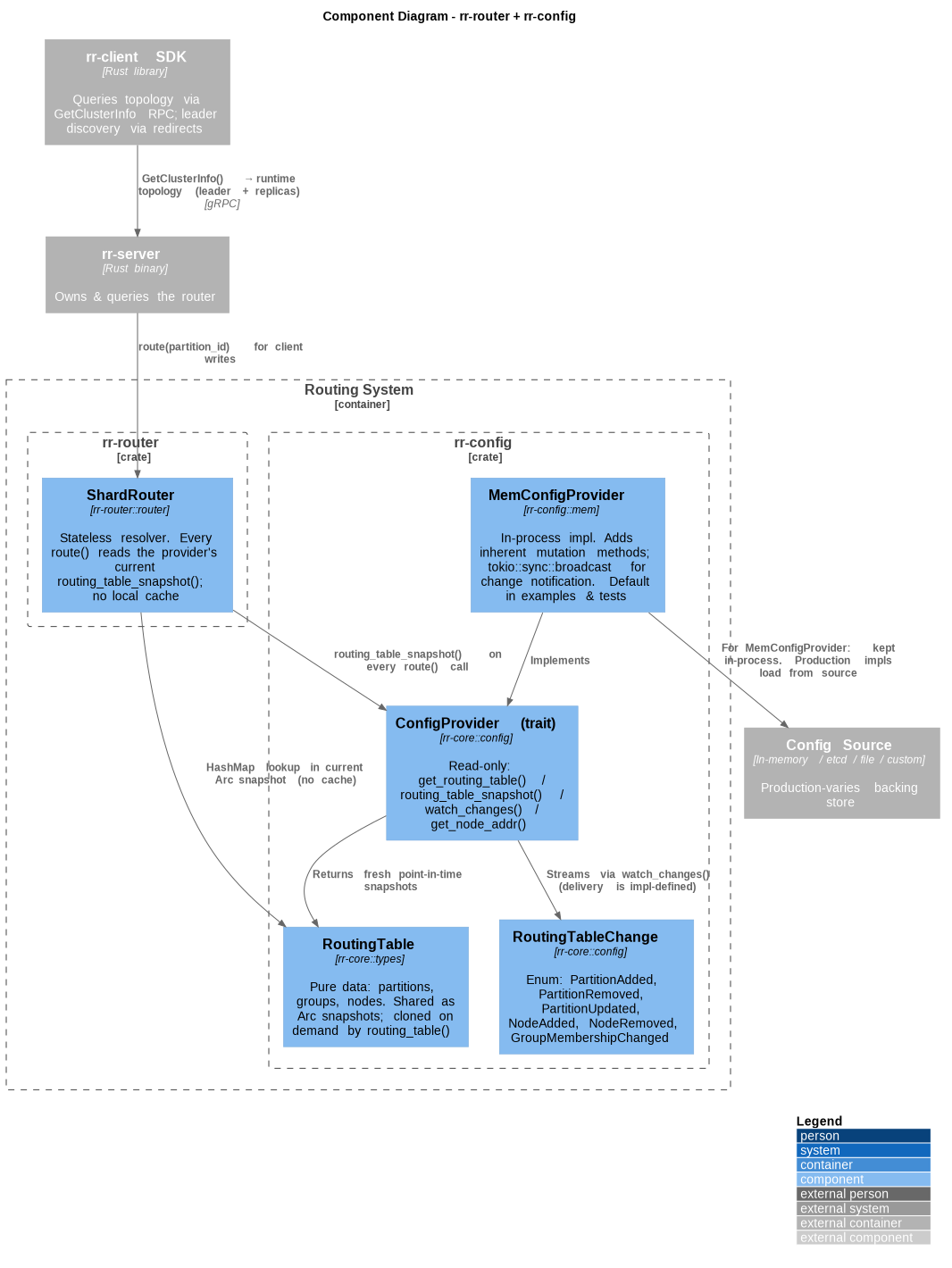
查看 PlantUML 源码 / View PlantUML source
@startuml
!include <C4/C4_Component.puml>

title Component Diagram - rr-router + rr-config

Container_Ext(rr_server, "rr-server", "Rust binary", "Owns & queries the router")
Container_Ext(rr_client, "rr-client SDK", "Rust library", "Queries topology via GetClusterInfo RPC; leader discovery via redirects")
Container_Ext(source, "Config Source", "In-memory / etcd / file / custom", "Production-varies backing store")

Container_Boundary(routing_system, "Routing System") {
  Boundary(router_crate, "rr-router", "crate") {
    Component(shard_router, "ShardRouter", "rr-router::router", "Stateless resolver. Every route() reads the provider's current routing_table_snapshot(); no local cache")
  }

  Boundary(config_crate, "rr-config", "crate") {
    Component(cfg_trait, "ConfigProvider (trait)", "rr-core::config", "Read-only: get_routing_table() / routing_table_snapshot() / watch_changes() / get_node_addr()")
    Component(mem_cfg, "MemConfigProvider", "rr-config::mem", "In-process impl. Adds inherent mutation methods; tokio::sync::broadcast for change notification. Default in examples & tests")
    Component(routing_table, "RoutingTable", "rr-core::types", "Pure data: partitions, groups, nodes. Shared as Arc snapshots; cloned on demand by routing_table()")
    Component(change_ev, "RoutingTableChange", "rr-core::config", "Enum: PartitionAdded, PartitionRemoved, PartitionUpdated, NodeAdded, NodeRemoved, GroupMembershipChanged")
  }
}

Rel(rr_server, shard_router, "route(partition_id) for client writes")
Rel(rr_client, rr_server, "GetClusterInfo() → runtime topology (leader + replicas)", "gRPC")

Rel(shard_router, cfg_trait, "routing_table_snapshot() on every route() call")
Rel(shard_router, routing_table, "HashMap lookup in current Arc snapshot (no cache)")
Rel(cfg_trait, routing_table, "Returns fresh point-in-time snapshots")
Rel(cfg_trait, change_ev, "Streams via watch_changes() (delivery is impl-defined)")
Rel(mem_cfg, cfg_trait, "Implements")
Rel(mem_cfg, source, "For MemConfigProvider: kept in-process. Production impls load from source")

LAYOUT_WITH_LEGEND()
@enduml
核心数据结构 / Core Data Structures
RoutingTable:路由表 / RoutingTable: Routing Table
rr-core::types 中的可序列化数据结构。
A serializable data structure in rr-core::types.
| 字段 / Field | 类型 / Type | 用途 / Purpose |
|---|---|---|
partitions | HashMap<PartitionId, (PartitionConfig, GroupId)> | 分片配置与所属 group / Partition config and owning group |
groups | HashMap<GroupId, GroupMeta> | group 副本;不含 leader / Group replicas; no leader |
nodes | HashMap<NodeId, NodeAddr> | 节点到 host:port 的映射 / Node-to-host:port mapping |
ShardRouter:分片路由 / ShardRouter: Shard Routing
代码位于 crates/rr-router/src/router.rs。
The implementation is in crates/rr-router/src/router.rs.
-
每次
route()都读取 provider 当前的routing_table_snapshot(),然后做一次 HashMap 查询; 不保留本地缓存。内存后端返回廉价Arc快照,不复制整表。Every
route()reads the provider's currentrouting_table_snapshot()and performs one HashMap lookup; no local cache is retained. The in-memory backend returns a cheapArcsnapshot without copying the table. -
未命中返回
PartitionNotFound并增加router.route.not_found。A miss returns
PartitionNotFoundand incrementsrouter.route.not_found. -
routing_table()通过同一快照路径返回按需拥有的完整副本,供RrNode::start()使用。routing_table()uses the same snapshot path and returns an owned full copy on demand forRrNode::start(). -
router 不订阅事件;
RrNode的 watch loop 消费watch_changes()并启停 group。The router does not subscribe;
RrNode's watch loop consumeswatch_changes()and starts or stops groups.
ConfigProvider:配置接口 / ConfigProvider: Configuration Trait
rr-core::config 定义只读接口:三个必需方法和一个默认快照方法。写方法不属于 trait。
rr-core::config defines a read-only interface: three required methods and one defaulted snapshot method. The
trait has no write methods.
#[async_trait]
pub trait ConfigProvider: Send + Sync {
    async fn get_routing_table(&self) -> Result<RoutingTable, ConfigError>;
    async fn routing_table_snapshot(&self) -> Result<Arc<RoutingTable>, ConfigError> { /* default */ }
    async fn watch_changes(
        &self,
    ) -> Result<Pin<Box<dyn Stream<Item = RoutingTableChange> + Send>>, ConfigError>;
    async fn get_node_addr(&self, node_id: NodeId) -> Result<NodeAddr, ConfigError>;
}
MemConfigProvider:内存实现 / MemConfigProvider: In-memory Implementation
crates/rr-config/src/mem.rs 持有 Arc<RwLock<RoutingTable>> 和
tokio::sync::broadcast::Sender<RoutingTableChange>。add_partition、add_node、
update_group_membership 等 inherent 方法更新表并广播事件。
crates/rr-config/src/mem.rs holds Arc<RwLock<RoutingTable>> and
tokio::sync::broadcast::Sender<RoutingTableChange>. Inherent methods such as add_partition, add_node, and
update_group_membership mutate the table and broadcast events.
每个节点的 MemConfigProvider 都是独立副本,不会自动同步。集群启动时必须为各节点配置相同初始表,
或使用分布式 provider。
Each node's MemConfigProvider is an independent copy with no automatic synchronization. Cluster nodes must
start with identical tables or use a distributed provider.
为什么使用路由表 / Why Table-based Routing
路由表允许按租户、时间范围或业务域明确控制分片归属,也便于直接检查。代价是必须维护并分发表;
这由 ConfigProvider 抽象承担。
A routing table gives explicit control over shard ownership by tenant, time range, or business domain and is easy
to inspect. The tradeoff is maintaining and distributing the table, which is abstracted by ConfigProvider.