动态:快照传输 / Dynamic: Snapshot Transfer
当 follower 缺失的日志已被 leader 压缩时,leader 通过 gRPC 客户端流发送完整状态机快照。
When a follower's missing log entries have been compacted on the leader, the leader sends a full state-machine snapshot over a gRPC client stream.
高层流程 / High-level Flow
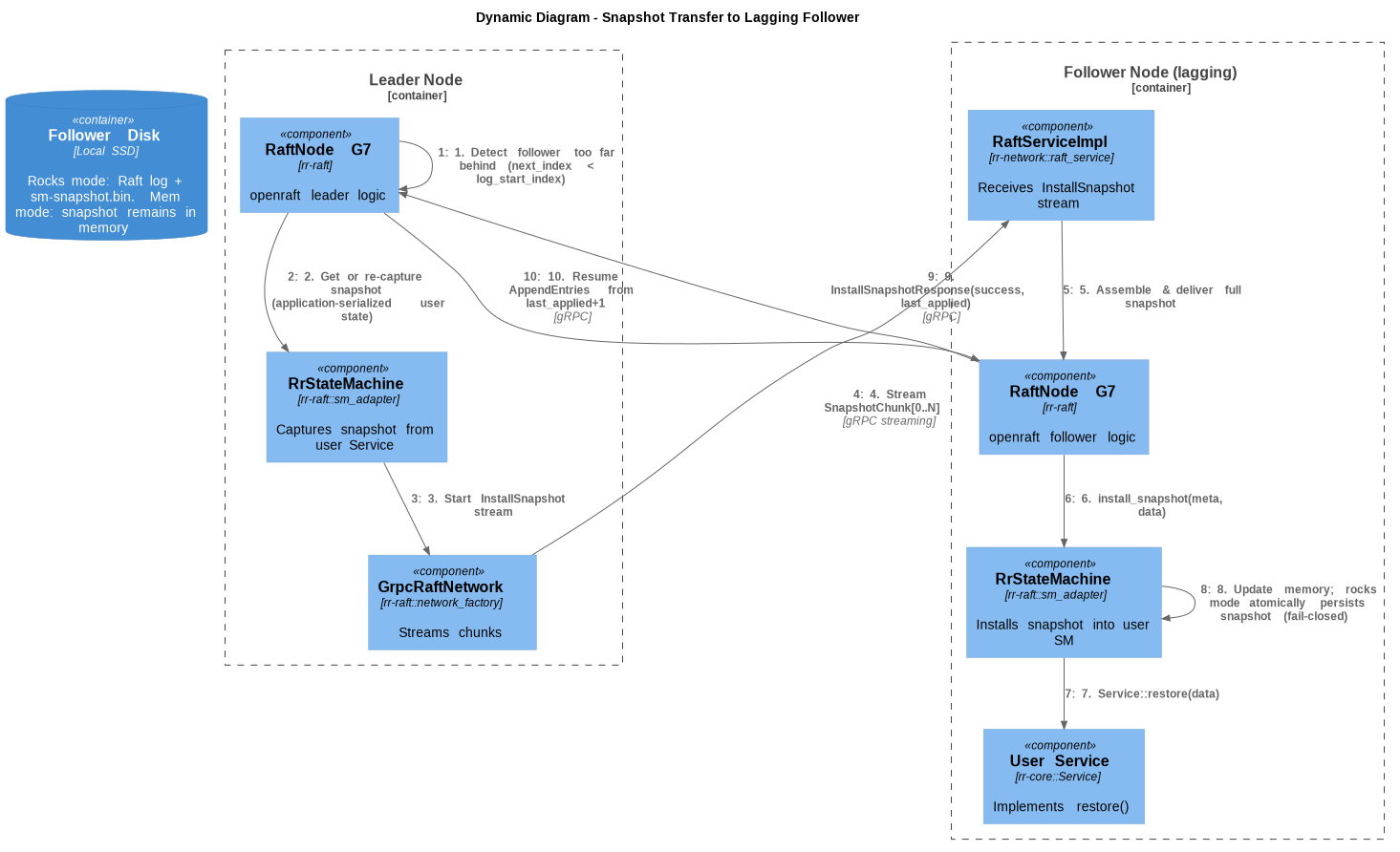
查看 PlantUML 源码 / View PlantUML source
@startuml
!include <C4/C4_Dynamic.puml>

title Dynamic Diagram - Snapshot Transfer to Lagging Follower

Container_Boundary(leader, "Leader Node") {
  Component(l_raft, "RaftNode G7", "rr-raft", "openraft leader logic")
  Component(l_sm, "RrStateMachine", "rr-raft::sm_adapter", "Captures snapshot from user Service")
  Component(l_net, "GrpcRaftNetwork", "rr-raft::network_factory", "Streams chunks")
}

Container_Boundary(follower, "Follower Node (lagging)") {
  Component(f_grpc, "RaftServiceImpl", "rr-network::raft_service", "Receives InstallSnapshot stream")
  Component(f_raft, "RaftNode G7", "rr-raft", "openraft follower logic")
  Component(f_sm, "RrStateMachine", "rr-raft::sm_adapter", "Installs snapshot into user SM")
  Component(f_svc, "User Service", "rr-core::Service", "Implements restore()")
}

ContainerDb(f_disk, "Follower Disk", "Local SSD", "Rocks mode: Raft log + sm-snapshot.bin. Mem mode: snapshot remains in memory")

Rel(l_raft, l_raft, "1. Detect follower too far behind (next_index < log_start_index)")
Rel(l_raft, l_sm, "2. Get or re-capture snapshot (application-serialized user state)")
Rel(l_sm, l_net, "3. Start InstallSnapshot stream")

Rel(l_net, f_grpc, "4. Stream SnapshotChunk[0..N]", "gRPC streaming")
Rel(f_grpc, f_raft, "5. Assemble & deliver full snapshot")
Rel(f_raft, f_sm, "6. install_snapshot(meta, data)")
Rel(f_sm, f_svc, "7. Service::restore(data)")
Rel(f_sm, f_sm, "8. Update memory; rocks mode atomically persists snapshot (fail-closed)")

Rel(f_raft, l_raft, "9. InstallSnapshotResponse(success, last_applied)", "gRPC")
Rel(l_raft, f_raft, "10. Resume AppendEntries from last_applied+1", "gRPC")

@enduml
详细时序 / Detailed Sequence
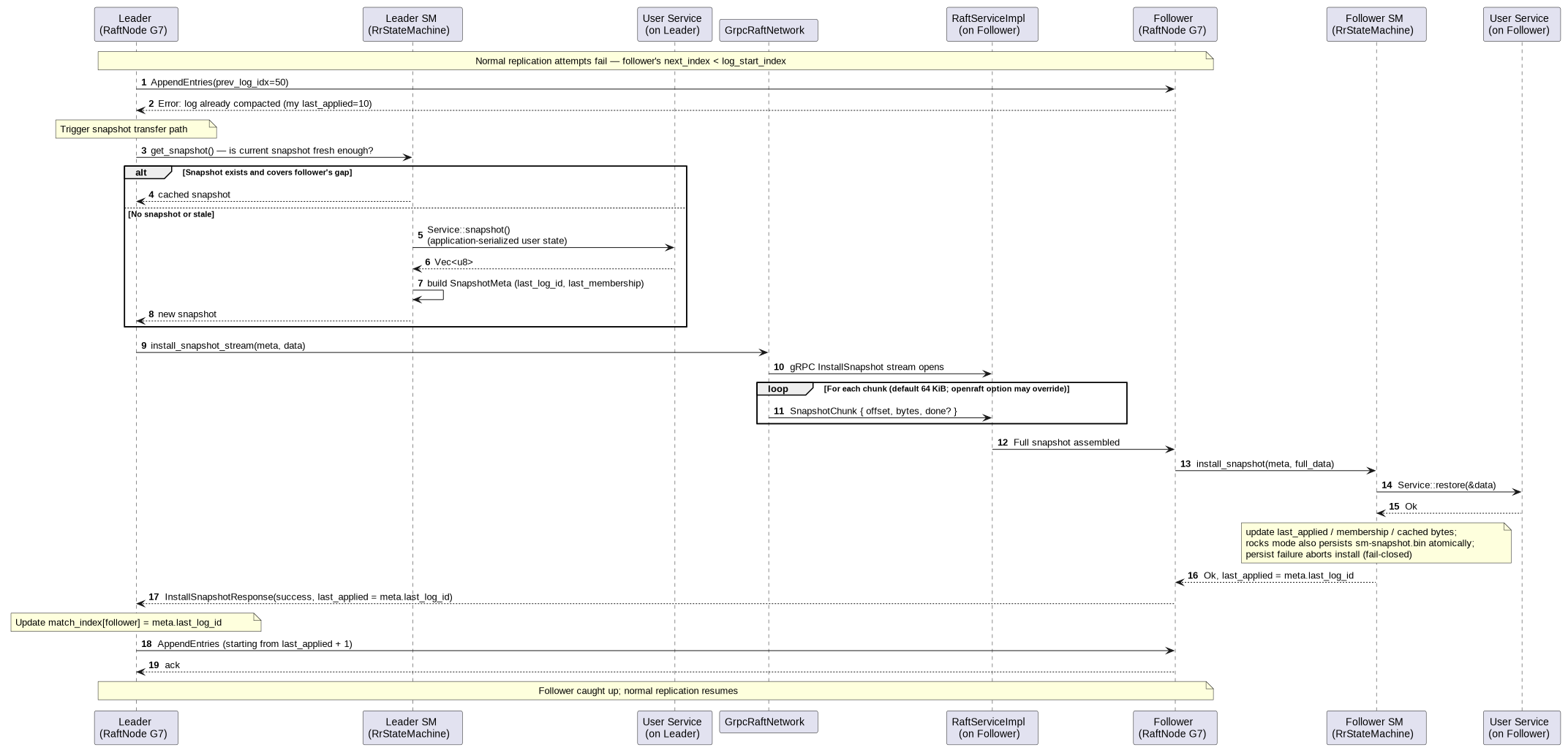
查看 PlantUML 源码 / View PlantUML source
@startuml
autonumber
participant L as "Leader\n(RaftNode G7)"
participant LSM as "Leader SM\n(RrStateMachine)"
participant LSvc as "User Service\n(on Leader)"
participant LNet as "GrpcRaftNetwork"
participant FNet as "RaftServiceImpl\n(on Follower)"
participant F as "Follower\n(RaftNode G7)"
participant FSM as "Follower SM\n(RrStateMachine)"
participant FSvc as "User Service\n(on Follower)"

note over L, F : Normal replication attempts fail — follower's next_index < log_start_index
L -> F : AppendEntries(prev_log_idx=50)
F --> L : Error: log already compacted (my last_applied=10)

note over L : Trigger snapshot transfer path
L -> LSM : get_snapshot() — is current snapshot fresh enough?
alt Snapshot exists and covers follower's gap
  LSM --> L : cached snapshot
else No snapshot or stale
  LSM -> LSvc : Service::snapshot()\n(application-serialized user state)
  LSvc --> LSM : Vec<u8>
  LSM -> LSM : build SnapshotMeta (last_log_id, last_membership)
  LSM --> L : new snapshot
end

L -> LNet : install_snapshot_stream(meta, data)
LNet -> FNet : gRPC InstallSnapshot stream opens

loop For each chunk (default 64 KiB; openraft option may override)
  LNet -> FNet : SnapshotChunk { offset, bytes, done? }
end

FNet -> F : Full snapshot assembled
F -> FSM : install_snapshot(meta, full_data)
FSM -> FSvc : Service::restore(&data)
FSvc --> FSM : Ok
note over FSM : update last_applied / membership / cached bytes;\nrocks mode also persists sm-snapshot.bin atomically;\npersist failure aborts install (fail-closed)
FSM --> F : Ok, last_applied = meta.last_log_id

F --> L : InstallSnapshotResponse(success, last_applied = meta.last_log_id)

note over L : Update match_index[follower] = meta.last_log_id
L -> F : AppendEntries (starting from last_applied + 1)
F --> L : ack

note over L, F : Follower caught up; normal replication resumes
@enduml
触发场景 / Triggers
-
新 learner 日志为空,且 leader 已压缩需要重放的日志。
A new learner has an empty log and the leader has compacted entries needed for replay.
-
节点长时间下线后恢复,
last_applied落后太多。A node returns after long downtime with
last_appliedtoo far behind. -
慢速或分区 follower 长期无法跟上,leader 最终截断其所需日志。
A slow or partitioned follower falls behind until the leader truncates the entries it needs.
大小与传输 / Size and Transfer
下表只是按 1 Gbps 理想带宽估算,不含序列化、磁盘和协议开销。
These are idealized 1 Gbps estimates and exclude serialization, disk, and protocol overhead.
| 场景 / Scenario | 快照大小 / Snapshot Size | 理论传输时间 / Ideal Transfer Time |
|---|---|---|
| 100 万键,平均 100 B / 1M keys at 100 B | ~100 MB | ~1 s |
| 1000 万键,500 B 值 / 10M keys with 500 B values | ~5 GB | ~40 s |
| 更大状态 / Larger state | ~50+ GB | 数分钟 / Several minutes |
-
默认 chunk 为 64 KiB;openraft 提供
snapshot_chunk_size时优先使用该值。OnlineBackup同样使用64 KiB。 Chunks default to 64 KiB; openraft's
snapshot_chunk_sizetakes precedence when provided.OnlineBackupalso uses 64 KiB. -
SnapshotPolicy::LogsSinceLast(N)控制快照阈值;Rr 默认N = 50_000,可用--snapshot-logs-since-last调整。SnapshotPolicy::LogsSinceLast(N)controls snapshot frequency; Rr defaults toN = 50_000, tunable with--snapshot-logs-since-last. -
GrpcRaftNetwork当前没有快照传输限流;大快照会与正常流量竞争资源。GrpcRaftNetworkcurrently has no snapshot-transfer throttling; large snapshots compete with normal traffic.
用户 Service 契约 / User Service Contract
应用负责生成一致、可恢复且版本兼容的快照字节。
The application owns consistent, restorable, and version-compatible snapshot bytes.
#[async_trait]
impl Service for MyService {
    async fn snapshot(&self) -> Result<Vec<u8>, RrError> {
        let guard = self.store.read().await;
        bincode::serde::encode_to_vec(&*guard, standard())
    }

    async fn restore(&mut self, data: &[u8]) -> Result<(), RrError> {
        let (restored, _) = bincode::serde::decode_from_slice(data, standard())?;
        *self.store.write().await = restored;
        Ok(())
    }
    // ...
}
-
snapshot()必须捕获同一时间点的一致视图。snapshot()must capture a consistent point-in-time view. -
restore()必须替换现有状态,而不是合并,以免保留陈旧条目。restore()must replace existing state rather than merge it, so stale entries do not survive. -
应用必须处理序列化格式的版本兼容。
The application must handle serialization compatibility across versions.
-
应用捕获在 openraft 状态机任务中直接
.await,不会自动移入spawn_blocking;实现不得长时间阻塞。Application capture is awaited directly on openraft's state-machine task, not automatically moved to
spawn_blocking; implementations must not block for long. -
rocks 模式将每个构建或安装的快照写入
{base_path}/{group_id}/sm-snapshot.bin。持久化 I/O 使用spawn_blocking,流程为临时文件 → fsync → rename → 目录 fsync。失败会中止构建或安装,阻止覆盖 日志前缀被 purge;损坏、缺少 envelope 或未知版本在启动时 fail-closed。In rocks mode, every built or installed snapshot is written to
{base_path}/{group_id}/sm-snapshot.bin. Persistence I/O usesspawn_blockingand follows temp file → fsync → rename → directory fsync. Failures abort the build or install before the covered log prefix can be purged; corrupt, unenveloped, or unknown-version files fail closed at startup. -
mem 模式的快照和日志不跨重启保留,节点需要从 leader 重建。
Mem-mode snapshots and logs do not survive restart; the node must rebuild from a leader.